
Introduction
Effective code management is important for successful software development, impacting team productivity and product stability. Tech giants like Google and Facebook grapple with vast amounts of code, raising the question of how they efficiently organize and handle their codebases. This article delves into the great repository debate: monorepos versus microrepos, drawing insights from the video below “Why Google and Meta Put Billion Lines of Code In 1 Repository?”
https://medium.com/media/61d0957e7ecd6258ed9e5c05fe3f5f73/hrefMonorepos: A Vast Library Under One Roof
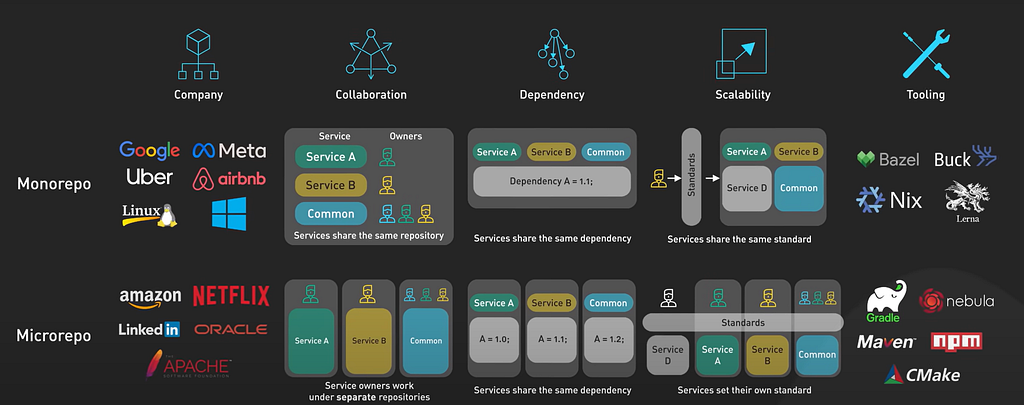
A monorepo, short for monolithic repository, is a single, centralized hub where all the code of a project or organization resides. Companies such as Google, Facebook, and Uber have embraced this approach, turning their monorepos into colossal libraries housing billions of lines of code. The monorepo strategy offers several advantages and challenges.

Pros of Monorepos
- Efficient Cross-Project Changes: Making changes that affect multiple projects is streamlined in a monorepo. For instance, modifications to a utility function used in several services can be executed with a single commit in one place.
- Dependency Management: Monorepos simplify dependency management by consolidating a unified view of dependencies, mitigating versioning conflicts across different repositories.
- Consistency: Enforcing consistent code standards becomes easier within a monorepo, fostering a unified approach to code reviews and development practices.
- Code Reuse: Monorepos encourage code reuse by providing a centralized location where existing functionalities can be readily repurposed for other services.
Cons of Monorepos
- Complexity and Tooling: Managing a monorepo demands careful planning and dedicated tooling. Large repositories like Google’s monorepo require specialized tools like Bazel and significant teams for support.
- Performance Challenges: As the repository grows, maintaining efficient CI/CD pipelines becomes a challenge, necessitating substantial staffing and optimized management.
- Overwhelming for New Developers: Navigating a vast monorepo can be overwhelming for new developers, emphasizing the importance of well-documented code and structured onboarding processes.
- Limited Customization: Customization within a monorepo can be constrained as teams must adhere to shared guidelines, restricting independent use of tools or libraries.
Check my previous article about How to manage large repositories:
Mastering GitHub: How to Manage Large Repositories like a Pro
Microrepos: Embracing Decentralization
Contrary to monorepos, microrepos treat each component or service as an independent entity, residing in its own separate repository. Tech giants like Amazon and Netflix adopt this decentralized approach to code management. Microrepos offer a distinct set of advantages and challenges.

Pros of Microrepos
- Independence and Scalability: Each team can independently manage and scale their repositories according to their specific needs.
- Risk Isolation: Problems within one repository do not cascade to others, reducing the potential blast radius in case of issues.
- Flexibility and Ownership: Teams can tailor their environments, choosing the most suitable tools for their repositories, and enjoy a sense of ownership over their codebases.
Cons of Microrepos
- Challenges in Coordinated Changes: Coordinating changes across multiple repositories can be challenging, requiring robust collaboration and possibly specialized tooling.
- Dependency Management: Managing dependencies across numerous microrepos can be complex, necessitating tools like Nexus or Artifactory.
- Code Quality and Consistency: Maintaining consistent code quality and patterns becomes a challenge due to the lack of unified standards. Clear organization-wide coding guidelines are essential.
- Code Duplication: Code duplication across microrepos can bloat the codebase and introduce bugs. Encouraging shared libraries for common code can alleviate this issue.
A Personal Thought: Module Repositories
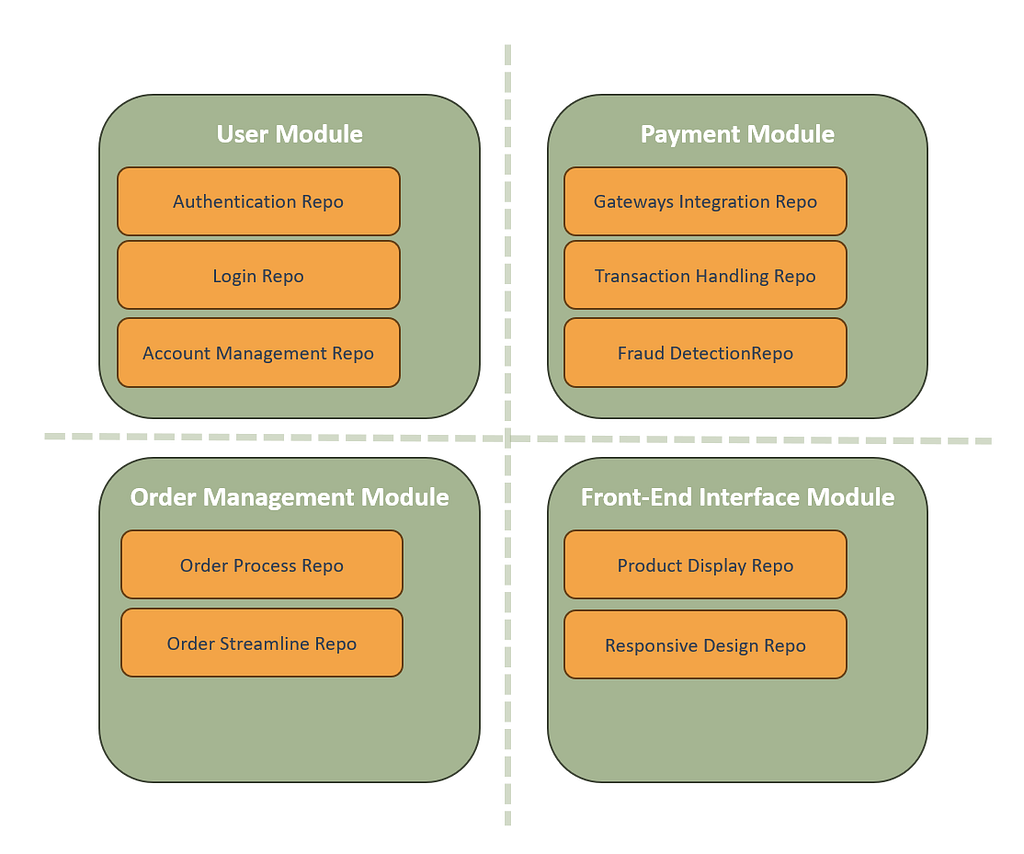
Instead of adhering rigidly to either monolithic or decentralized strategies, organizations can effectively leverage module repositories by structuring their codebase around logical modules.
Imagine an e-commerce platform employing module repositories. Different aspects of the platform, such as user authentication, payment processing, order management, and the front-end interface, would each have their dedicated module repository. Each repository encapsulates the specific functionalities related to its aspect, promoting modularity and ease of management. Something like this:
By incorporating module repositories into their codebase, the e-commerce platform benefits from:
- Modularity and Isolation: Each repository operates as an independent module, facilitating focused development and maintenance.
- Ease of Scaling and Maintenance: Scaling and maintaining individual modules become simpler and more efficient, promoting agility in development.
- Enhanced Reusability: Modules can be reused across various projects or components, optimizing development efforts.
- Streamlined Collaboration: Teams can collaborate more effectively on specific functionalities, enhancing productivity and project management.
Choosing the Right Approach
The decision between monorepos and microrepos isn’t a one-size-fits-all scenario. The choice depends on various factors, including the organization’s size, project nature, team needs, and overall company culture.
Monorepos are Ideal When:
- Large teams collaborate on interconnected projects.
- Consistency, code reuse, and centralized management are paramount.
- Rigorous planning and careful tooling are feasible.
Microrepos are Ideal When:
- Teams work on distinct projects with different needs and technologies.
- Independence, risk isolation, and flexibility are prioritized.
Module Repositories are Ideal When:
- The organization seeks a balance between modularity and centralized control.
- Granular organization of code while maintaining centralized management is desired.
- Specific aspects or functionalities of the system can be effectively encapsulated in separate modules.
- Robust collaboration and communication are established across teams.
Conclusion
Like most software development approaches, there is no definitive answer to the monorepo versus microrepo debate. Both approaches have their merits and challenges, and the key is to align the chosen strategy with the specific requirements and dynamics of the organization. Whether it’s the centralized harmony of a monorepo or the decentralized freedom of microrepos, success lies in making an informed decision that best suits the organization’s goals and projects.
Thanks for reading!