
Secure authentication is the backbone of modern applications. Two widely adopted approaches to authentication are Session-based authentication and JSON Web Tokens (JWTs). Each has its own strengths and challenges, and knowing when to use which can significantly impact your application’s security and scalability.
This article is a follow-up to my earlier post, “Understanding the Differences Between Cookies, Sessions, and Tokens”, and will explore these two methods in more detail.
Understanding the Differences Between Cookies, Sessions, and Tokens
Session-Based Authentication
How It Works
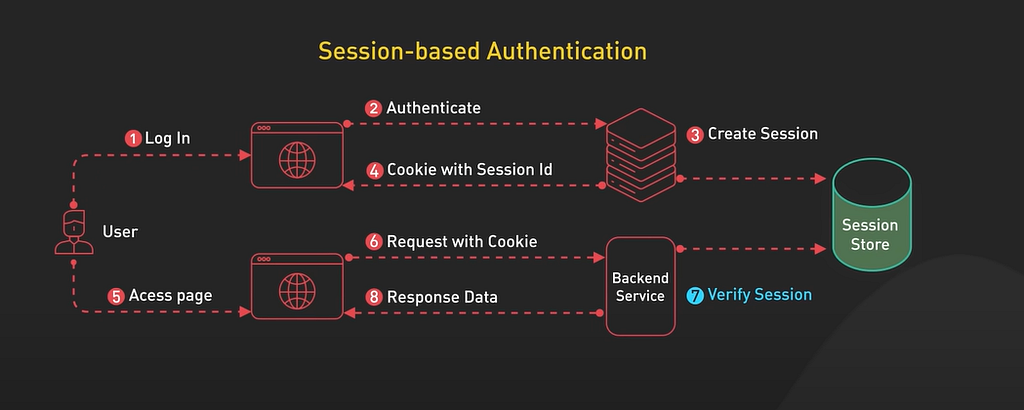
- Login Request: The user sends their login credentials to the server.
- Server Validation: The server verifies the credentials.
- Session Creation: Upon successful validation, the server creates a session and stores session data (e.g., user ID, expiration time) in a centralized store like a database or cache.
- Session ID: The server sends a session ID to the client, typically stored as a cookie.
- Subsequent Requests: For each subsequent request, the client automatically includes the session ID. The server uses this ID to retrieve session data and authenticate the user.
Advantages
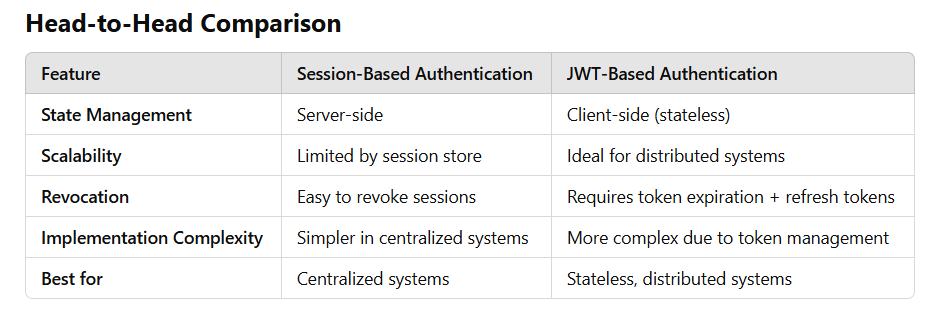
- Easy Revocation: Since the server maintains the session, invalidating or revoking a session is straightforward. This is particularly useful for scenarios where immediate access termination is critical.
- Centralized Control: The server has full control over session data, making it easier to manage user state.
Challenges
- Distributed Systems: For applications running on multiple servers, a centralized session store (e.g., Redis or a distributed SQL database) is required. This adds complexity and latency.
- Scaling Limitations: The server must manage session storage, which can become a bottleneck as the application scales horizontally.
Best Use Cases
- Applications that require instant session termination, such as admin dashboards.
- Systems with an existing centralized data store that can be leveraged for session storage.
JWT-Based Authentication
How It Works
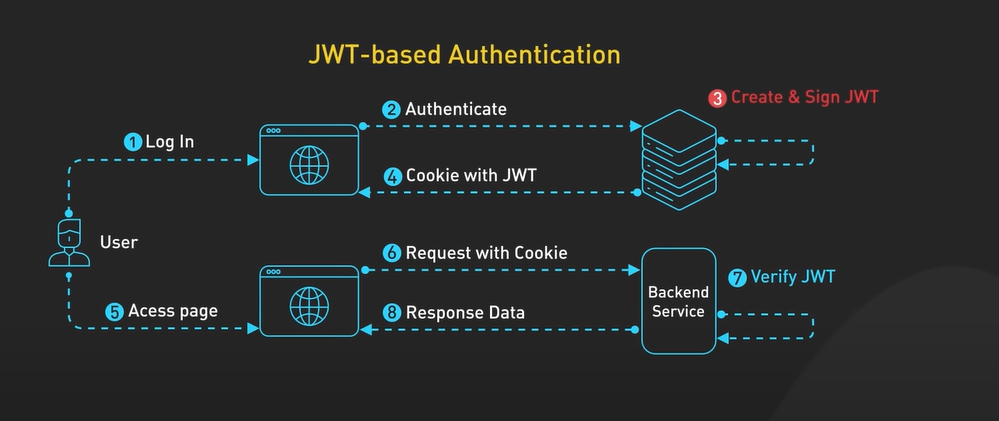
- Login Request: The user sends their login credentials to the server.
- Server Validation: The server validates the credentials.
- JWT Generation: Upon successful validation, the server generates a JWT signed with a secret or private key.
- Token Delivery: The JWT is sent to the client and stored (e.g., in local storage or a cookie).
- Stateless Authentication: On subsequent requests, the client includes the JWT in the request headers. The server validates the signature and uses the token’s data for authentication.
Advantages
- Stateless Architecture: The server doesn’t need to maintain session state, making this method ideal for scaling horizontally across multiple servers.
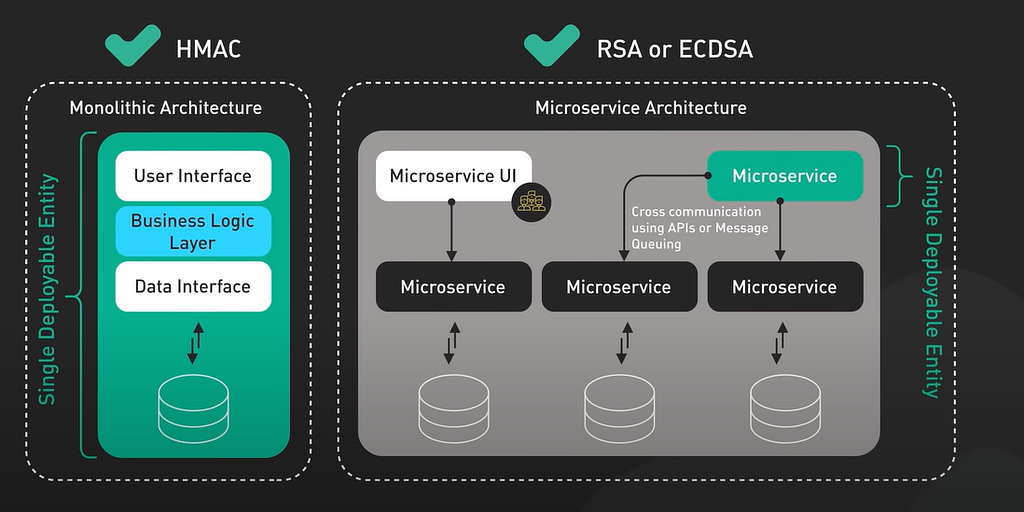
- Cross-Service Compatibility: JWTs can be used across microservices, allowing services to verify the token without contacting the authentication server.
- Flexibility: Supports various signing algorithms like HMAC, RSA, and ECDSA, each catering to different security needs.
Challenges
- Token Expiration: A stolen JWT can be used until it expires. To mitigate this, short-lived access tokens are often combined with long-lived refresh tokens.
- Increased Complexity: Managing refresh tokens and ensuring secure token storage on the client adds complexity.
Best Use Cases
- Distributed systems or microservice architectures that require authentication across services.
- Applications where statelessness is a priority for scalability.
Security Considerations
- Session-Based Authentication:
- Centralized session storage keeps sensitive data on the server, reducing client-side risk.
- Requires secure cookie handling to prevent session hijacking
2. JWT-Based Authentication:
- Tokens are signed, not encrypted. Sensitive data should not be stored in the token.
- Implement refresh tokens for added security and better user experience.
- Use asymmetric signing (e.g., RSA or ECDSA) for better security in distributed architectures.
Making the Right Choice
Choose Session-Based Authentication If:
- You need instant session termination for compromised accounts.
- Your system already has a centralized infrastructure for session management.
Choose JWT-Based Authentication If:
- Your application relies on statelessness for scalability.
- You are working with a microservice architecture that requires cross-service authentication.
Hybrid Approach: The Best of Both Worlds
In some cases, a hybrid approach may work best. For example:
- Use JWTs for stateless, distributed authentication.
- Combine this with a refresh token mechanism to handle token expiration securely.
Conclusion
Authentication is not one-size-fits-all. The decision between session-based authentication and JWTs depends on your application’s architecture, scalability needs, and security requirements.
By understanding the trade-offs, you can design an authentication system that’s not only secure but also scales with your application.
Thank you for reading! See you next time.